In- und Ankreisradien

In diesem Abschnitt werden Formeln aufgelistet, in denen der Inkreisradius $?$ und die Ankreisradien $?_{a}$, $?_{b}$ und $?_{c}$ des Dreiecks $ABC$ vorkommen.

$\displaystyle \rho =\left( s-a\right) \tan \frac{\alpha }{2}=\left( s-b\right) \tan \frac{\beta }{2}=\left( s-c\right) \tan \frac{\gamma }{2}$

$\displaystyle \rho =4r\sin \frac{\alpha }{2}\sin \frac{\beta }{2}\sin \frac{\gamma }{2}=s\tan \frac{\alpha }{2}\tan \frac{\beta }{2}\tan \frac{\gamma }{2}$

$\displaystyle \rho =r\left( \cos \alpha +\cos \beta +\cos \gamma -1\right)$

$\displaystyle \rho =\frac{F}{s}=\frac{abc}{4rs}$

$\displaystyle \rho =\sqrt{\frac{\left( s-a\right) \left( s-b\right) \left( s-c\...
...sqrt{\frac{\left( b+c-a\right) \left( c+a-b\right) \left(a+b-c\right) }{a+b+c}}$

$\displaystyle \rho =\frac{a}{\cot \frac{\beta }{2}+\cot \frac{\gamma }{2}}=\fra...
...+\cot \frac{\alpha }{2}}=\frac{c}{\cot \frac{\alpha }{2}+\cot \frac{\beta }{2}}$

$\displaystyle a\cdot b + b\cdot c + c\cdot a = s^2 + \rho^2 + 4\cdot\rho\cdot r$

Wichtige Ungleichung $2\rho \leq r $ ; Gleichheit tritt nur dann ein, wenn Dreieck $ABC$ gleichseitig ist.

$\displaystyle \rho _{a}=s\tan \frac{\alpha }{2}=\left( s-b\right) \tan \frac{\gamma }{2}=\left( s-c\right) \tan \frac{\beta }{2}$

$\displaystyle \rho _{a}=4r\sin \frac{\alpha }{2}\cos \frac{\beta }{2}\cos \frac...
...t( s-a\right) \tan \frac{\alpha }{2}\cot \frac{\beta }{2}\cot \frac{\gamma }{2}$

$\displaystyle \rho _{a}=r\left( -\cos \alpha +\cos \beta +\cos \gamma +1\right)$

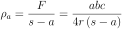
$\displaystyle \rho _{a}=\frac{F}{s-a}=\frac{abc}{4r\left( s-a\right) }$

$\displaystyle \rho _{a}=\sqrt{\frac{s\left( s-b\right) \left( s-c\right) }{s-a}...
...qrt{\frac{\left( a+b+c\right) \left( c+a-b\right) \left( a+b-c\right) }{b+c-a}}$

Die Ankreise sind gleichberechtigt: Jede Formel für $?_{a}$ gilt in analoger Form für $?_{b}$ und $?_{c}$.

$\displaystyle \frac{1}{\rho }=\frac{1}{\rho _{a}}+\frac{1}{\rho _{b}}+\frac{1}{\rho _{c}}$